

| Map showing the provinces of Thailand affected |


Hundreds of holiday bungalows on the Phi Phi Islands were washed out to sea. Tuk-tuk drivers were quick to offer assistance, driving victims to hospital and higher ground and away from the surging waters. Bhumi Jensen, grandson of HM King Bhumibol Adulyadej, was among those killed. At some places in Phuket and Phang Nga provinces, elephants were used to move and lift heavy wreckage to search for victims and clear roads. These were, or included, six male Indian elephants which had previously been used in making the movie Alexander. On a beach in Thailand, a man was leading an elephant to entertain tourists, when the tsunami came. He put several children on the elephant's back and so saved them from the flood. |
Thai authorities estimate 10,000 are likely to have died. The popular tourist resort of Phuket was badly hit. The smaller but increasingly popular resort area of Khao Lak some 80 km north of Phuket was hit far worse with over 5,000 confirmed deaths. The severity of the situation in Khao Lak is probably explained by the fact, that unlike the high-rising city of Phuket, the village of Khao Lak only had low built bungalows instead of high-rise concrete hotels. Khao Lak also has an extensive area of flatland only a few metres above the sea level, on which most bungalows were situated. |
A month after devastating waves struck this idyllic southern province, tsunami survivors are still struggling to come to terms with irrevocable losses. “My four children are still missing. I have yet to find them,” a grief-stricken Tawil Duangsai of Baa Nam Khem said. He has already found six members of his family, including his wife: they all perished on December 26. Tawil only survived because he was out on the open sea, fishing. “The waves hurled me back to the shore,” he said. As soon as he recovered his presence of mind, he went in search of his family. The loved ones he could find were all dead. Tawil has spent the past month scurrying between local temples that have doubled as makeshift morgues and body-identification centres, hoping that he could recover his missing children’s remains for a parting act of compassion: granting them proper funeral rites. “I will have to keep on searching.” Tawil is one of many who remain unable to find closure for their pain. |
“Julie, of California was sailing off the Thai coast when the wave roared by. She began pulling aboard survivors. Casey, her son, jumped into a dinghy to rescue some nearby floundering children. Julie was discouraged to see other boats hanging back, their passengers fearful of getting involved. The scene evoked images of the sinking of the Titanic, when all but one of the lifeboats stayed away as the great ship went down, lest they be overwhelmed and perish, too.” |

Khao Lak stood the waves directly. The beaches are much shallower and longer than those of Phuket. Based on an assessment by Japanese tsunami experts, the waves at Khao Lak were around 11.8m high. Located 40km south of Khao Lak, Phuket was luckier on two grounds: the "head" of Sumatra island blocked the tsunami direct waves and Phuket beaches are steeper & shorter, allowing less tidal wave height to form; the tsunamis at Phuket were estimated around 3.5m high. Phi Phi on the east of Phuket was in turn blocked by Phuket; unfortunately, because of Phi Phi construction codes which do not allow high rise buildings, even smaller tidal waves did cause severe damages. Khao Lak area is a 25-km long coastline. Having everything from five-star luxury hotels to low cost hostels, Khao Lak had something to entertain people of different requirements. |
Khao Lak is the hardest hit area because from waterfront, one had to run up hill to escape the waves. From satellite pictures, the water came up around 800m into land, and in some areas even further. With the tsunami’s speed it's hard to make a kilometre run in a minute and so escaping the wave was next to impossible. Two dolphins were carried away 1.5km inland to a land-locked pond. Khao Lak is the nearest point from mainland to the Similan islands which is a world-class diving spot -- straight off the sea on the west. |
At least 2,400 fishing boats have been destroyed and 54,000 farm animals killed, according to official Thai estimates. Some 6,000 houses, 50 schools and 19 government buildings are also reported to be damaged or destroyed. |
Along with my Thai wife, Waree, and our daughter Alesha we were scheduled to be in Thailand from December 30th. Working from my house in Lamphun in the north is not difficult given the power of ‘broad band’. Two weeks there followed by two weeks holiday in Phuket have become our normal annual January schedule. Instinctively we felt the need to cancel the Phuket vacation as it seemed unthinkable to be relaxing in the sunshine in the aftermath of the Tsunami. Friends living in Phuket had mixed feelings about our revised plans as they understood only too well the need to get visitors coming back to the region for the sake of the economy and not least for the morale of the population who largely relied upon tourism. They were already terrified that ‘farang’ (foreign visitors) would not want to return. |
We had been impressed and encouraged by my pal’s efforts in assisting those displaced – a number of pickup loads of supplies had been delivered to the camps where thousands of families had been forced to relocate. Still uncertain if we were morally entitled to do so we never the less decided to travel to the turmoil of the south with the idea that we might somehow be helpful. With bereavement counselling as part of my charity work training (Northampton Victim Support) I sought to discover if these skills might be utilized usefully. We already knew that we should at least be able to replicate my friends’ efforts with buying and delivering supplies. We had been warned that although basic food and water were adequately available, other more specialist essentials such as baby formula, nappies, bottles and the like were still in very short supply. |

| “Heart rendering message boards with pleas for help in finding loved ones were immediately apparent on arrival.” |
We left the day after our new house blessing by family and local Monks had taken place in Lamphun which is south 25 km's of Chiang Mai and arrived in Phuket on 14th January. Frankly I could not help but think that by this time, despite the scale of the tragedy, and after considering the huge generosity of country’s everywhere, that the people would have everything they could ever need – at least in terms of essentials and even some basic comforts ……… |
…. a number of my expectations and perceptions were about to be proved entirely wrong …. |

We arrived in Phuket on Friday 14th and made contact with an American guy and his Thai girlfriend who between them had been the first to organise some of the camps and immediate relief work. They normally worked in Bangkok as writers but dropped everything to see what they could do in the south. They found themselves involved in relief work they could never have imagined. Without previous experience they soon became coordinators of 100’s of volunteers (Thai and international) covering 28 camps in the Khao Lak and Takua Pa areas. They were also used as liaison between the US military and Thai authorities and so they were well informed and knew what was required on a day by day basis. Disturbingly, they explained that they would be leaving within a few days as the Thai authorities wanted to reclaim responsibility for the work being done – they were being invited “to take a well earned rest”. They invited us to visit them in Takua Pa so that they could show us around some of the camps where we could make our own assessment of what we might accomplish by helping. They confirmed that baby’ s milk, special food formulas and nappies were still in short supply and so we made our first shopping trip that night so as to fill our CRV with as much aid as we could travel with. The journey the next day took longer than we had expected due to the roads being so busy with excavation transport and heavy earth moving equipment – the usual 90 min ride took twice that time. As soon as we reached the Thai Muang National Park area we started to understand the scale of what had happened there. The landscape was more like a moon scape in the areas where they had started clearing. Where this was not yet done it was if a massive explosion had torn down the buildings and vegetation. The next 25 kms did not vary in terms of the devastation, there was cruel evidence every where of the destructive power of the waves. In this area the waves were almost as high as 12 mts and travelled in land as far as 1.5 kms. At times the coast road was a km in land but we still had severe damage on the opposite side of the road to the sea. The military along with an army of other local people were busy clearing areas which looked as though it would take years to accomplish. Over to our right more than a km inland now was the Police patrol boat, almost undamaged, which was guarding the Kings grandson and family who were themselves holiday in the area. Most regrettably he was amongst those who were overwhelmed by the force of the waves on the 26th. The waves were totally indiscriminate in that they took whoever or whatever was in its path that dreadful day; 5 star resorts, fishing villages, holiday homes and small businesses, local people, visitors from all over the world as well as a prince of the realm - all gone. |
Our first car loads were enthusiastically received at the temporary camps and schools. The first couple of journeys were without cameras as we were keen to look like aid workers rather than tourists. Our impression was that if we had visited without aid we would have been made just as welcome. Being made to feel that the world understood what was happening and that they cared was what was important to them. |


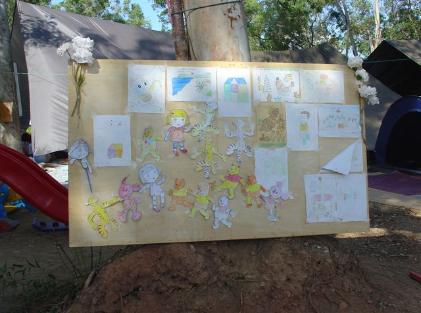
They had mountains of clothes; as per the pictures above and left. This was my first impression and I remembered thinking that if this was typical of their supply situation then they would be wanting for nothing, at least for their immediate needs. |


The tents in the picture above were from the Baa Maung camp where around 1,000 families were being accommodated. The day we first visited (3 weeks after the Tsunami) we saw the first few families being moved into temporary ‘houses’, these consisted of tin roofs and plywood sides made in blocks which were reminiscent of what we saw of the concentration camps in WWII. In my picture above right the tent had the names of six family members. There would not have been room for even one person to lie flat, but six! The family explained to us that each night they would see if there was room in another tent for a couple of them to sleep. They told us not to worry about them they were fine – they were alive and felt safe as the land at the camp was much higher than their village had been. Large kitchens tended to meal times as the families were not allowed to cook in or around the tents. They longed to get into the temporary houses where they would be able to cook and use electricity again. When getting food from the kitchens (where they did seem to have plenty of food) families told us that they were embarrassed to fill their plates as the queues were so long and they did not want to risk depriving anyone else of their share. Main problems were the heat and the dust and the feeling amongst them that the ‘temporary homes’ would be too permanent and the longing to get back to work and some normality. |





The Thai coast, some 300 miles from the quake, was soon to be hit. The area has some of the most beautiful beaches in the world; tourists flock there. Coming off a recent divorce in Britain, Jack Davison was looking forward to sun, romance and adventure during his Christmas holiday in Thailand. The 57-year-old retired schoolmaster was walking near Patong Beach on Sunday morning when he noticed a crowd of Western tourists and locals staring curiously out to sea. The water seemed to have vanished from the shore. Then the crowd noticed a small wall of white water about a mile out. Within seconds, the wall loomed larger and began tossing yachts and fishing boats like toys as it barrelled in. |
“I will have to keep on searching.” |
Tsunami in Asia
Thailand's Tsunami
Thailand's Tsunami resulting from the 2004 Indian Ocean earthquake
The people around Davison began to scream. Too late, Davison and the others turned to run. The Briton was pinned beneath a car as both he and the vehicle were swept away. "It went totally dark, and the only thing I could see was the wheel of the car on top of me and the exhaust pipe. I thought that was it," recalled Davidson. Suddenly, he was wrenched free and came up gasping. He watched in horror as a young European couple, completely naked, washed out of the window of their ground-floor room at the Sea Gull Hotel just before a car smashed into the window frame. One of the young Europeans was a 29-year-old Italian named Dario Tropea. He and his female companion had been abruptly awakened by a torrent of water in their hotel room. In five seconds, the water level had risen to within inches of the 10-foot ceiling, leaving the trapped couple no choice but to link arms and dive through the window. Tropea lost consciousness. "When I woke up, I couldn't see the hotel, and I thought it had collapsed." Tropea found his shocked, naked companion, and they started back to look for friends — when they saw a second wave. "People were screaming, calling out for us to run, and car horns jamming as they crashed into the hotel," recalled Tropea, as he sat, dazed and injured but alive, in a hospital room two days later. |
Almost 10,000 likely to have perished in Thailand
The scale of human tragedy is indescribable
 |
 |
 |
 |
 |
 |
 |
 |
 |
A Personal Viewpoint
To Go or not to Go ?? ...
Upon arrival in Phuket ...
Life within the Camps around the Khao Lak area ...
Waree and Peter Warsop
Northampton UK
Northampton UK
| We quickly learnt that if we were going to make any kind of difference to the lives of those within the camps we would have to gear up our efforts considerably and start moving from car loads of aid to lorry loads. See 'Our Aid Flows' for the next stage |