


Maitree Jongkraijak, a community leader in Baan Nam Khem, stressed he and like-minded fishermen wanted to return to their old neighborhoods, which were devastated by the giant waves, because temporary shelters set up by the government were too far inland. “As long as we remain here, we won’t be able to fish,” he said. “We’re good only at fishing and don’t know how to earn a living any other way." |
Orphaned children, especially, are finding it hard to return to a life of normality and resume their studies, said Ounjit Wangnara, assistant director of Baan Nam Khem School. “Some children have lost a parent. Others have lost both parents,” he said. “Most of them are still unable to move on.” |



The two guys opposite were the head men at the large Baan Maung camp. The one on the left was the senior although after a few meetings of getting to know us he explained that he was not the most senior. The original head man was still alive but unable to cope with the enormity of the problems being faced and the seemingly impossible task ahead. He remained in the destroyed village supervising some rebuilding but preferring not to have to deal with the villagers directly. Maithree, the acting head man, had lost his father in the Tsunami but felt lucky to have been able to save his wife and two children. He felt his own survival was a miracle and that this was no doubt because he was needed to help with the rebuilding the community, these thoughts kept him going during the many times he felt most dismayed. His deputy, on the right of the picture, told us how he had been fishing when the Tsunami struck – almost 2 km out at sea. He had his 12 year old daughter with him when the waves reduced his boat to nothing. He managed to tie her to him and struggled in the water for four hours before being rescued by another boat. |

“No matter how hard I try, I just can’t concentrate in class,” Saowalak Muthavej, a fifth grader, said. “I can’t just accept what happened. I just can’t.” And even the school remains a constant reminder of the tragedy, she said. “Look, the destruction here is still so plain to see,” Saowalak said, pointing to the rubble. |

More than 20 parents have taken their children to other provinces that were not affected by the tsunami to help them forget the disaster faster, Ounjit said. “Parents are concerned that their children might remain sad and dejected if they have to see scenes of devastation every day,” he said. Some locals,though, are eager to reconcile with the sea. |

The stranded police patrol boat pictured above will be left in situ’, around 1 km inland, and be a reminder of the power of the sea. It seems almost undamaged, and was guarding the Kings grandson and family who were themselves on holiday in the area. Most regrettably he was amongst those who were overwhelmed by the force of the waves on the 26th. |
The head man promised that they would start building a boat yard within a couple of days, and they did. |
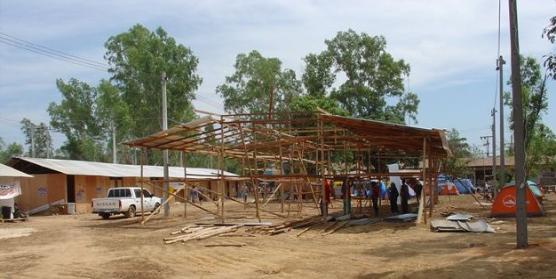

The progress made over those next two days can be seen in the pictures above as the boat yard started to take shape. We spoke to a boat supplier in Krabi on the opposite coast and found that we could organise the supply of sufficient nets and boat tackle to fit out the 10 boats that were going to build – our third lorry load was underway! |

In The Kao Lak area there were many hotels and resorts. Out of 32 listed in one holiday guide I counted that 29 were destroyed or badly damaged. They will no doubt be rebuilt, bigger and better than before. Work has already started on some of them and the government are agreeing readily for new construction in the devastated areas. |

The Thai people will never forget their human losses but most have decided they must focus on preparation for the future – because their own and their children’s livelihood and mental health depend upon it. They also feel challenged to make good effect of the kindness and charitable nature of the thousands that have sent them help and good wishes – they intend to waste none of it |
Phuket Jan 28th 2005 - “A lack of clear government policy has stopped help getting to the most vulnerable tsunami victims including migrant workers and small fishermen”, a seminar was told here yesterday. |
The government would have been disappointed to hear criticisms of any nature especially as they have genuinely tried extremely hard to minimise suffering. What ever, or however efficient the system it would be difficult to imagine that it would be able to cater for all of the problems in every situation and perhaps this is why the independent non political volunteers will always be an essential element in any disaster. When organisations hold millions of $$ of other peoples money they are likely to weigh very carefully how any funds are spent – this inevitably means delays in some projects and with aid getting through. |
To wait for government direction and for organisations to commit their cash will sometimes mean those affected will be going short of much of what they need in the short or even medium term. The number of volunteers in the region both Thai and foreign was heart warming. Some were helping in the temples with the victim identification process, I met some of them and they surely have the worst job of any. Others were working in the camps, some clearing beaches, translating, building furniture and many were helping with the building of temporary homes. Others were enlisted to work on computers to maintain missing people and identification listings – all of them incredibly useful. |


“Some children have lost a parent. Others have lost both parents,” he said. “Most of them are still unable to move on.” |
Tsunami in Asia
Baan Nam Khem
Please look at what has happened to our village!
In talking to the families we were constantly being asked if we had seen their village since the Tsunami. Most of them had come from the Baan Nam Khem area which was said to be almost totally destroyed. They explained that before the Tsunami they were a happy but hard working community. We were compelled to be understanding of what they tried to describe so we visited what remained of their town. Almost all housing in the area had been destroyed and more than 300 fishing boats had been lost, amongst them some large trawlers. The head man explained that just over 500 villagers had died. These were the ones which were officially registered at the Ampher office (local council) where all residents and workers would be recorded. In addition to those officially recorded he assessed that between 1,500 and 2,000 other workers could have been lost. The thought of these assumptions were shocking but the reality is that they were probably fairly close to the reality of the situation. There were large numbers of Burmese workers in the area plus other Thai and foreign workers and visitors that would not have been registered at the local Ampher office. |
Chokechai Ploysikham, a seventh grader, has been lending a hand to his teachers rebuilding the school. “I’ve completely lost interest in my studies,” the boy said. “I keep thinking of my two best friends who both died.” Other students live in fear that like a vengeful beast the tsunami might strike again. |
Village Hierarchy ....
 |
 |
 |
 |
 |
 |
 |
 |
 |
Hope and expectation on the Horizon ...
The Thai government had promised to help the fisherman get back to work with a substantial amount of cash being promised for each boat lost – perhaps a little more than half the cost. Also, the head man of Baa Nam Khem returned from Bangkok 10 days ago after seeing several of the institutions that were holding funds for redevelopment. Cash was pledged and new boats would eventually be provided – However, the timing for this remained a grey area. He returned and decided that they needed to do something themselves that would illustrate to everyone that they just had to get back into work without delay – they would build their own boat yard right there on the temporary camp site. He promised me that they would start within a couple of days and they did. As the tents were cleared when new temporary houses were made ready the space was created for work to begin. The plan was to build 10 new boats initially. He was afraid that if some men did not get back to work soon it would further create problems for them in reconciling their problems with the sea for taking so many of their loved ones. |
Where there is a will, there is a way ...
| There are many organisations in Thailand that are coordinating volunteer help, most are looking for long term commitments rather than short term helpers. One such organisation is; |
| www.tsunamivolunteer.net |
Waree and Peter Warsop
Northampton UK
Northampton UK